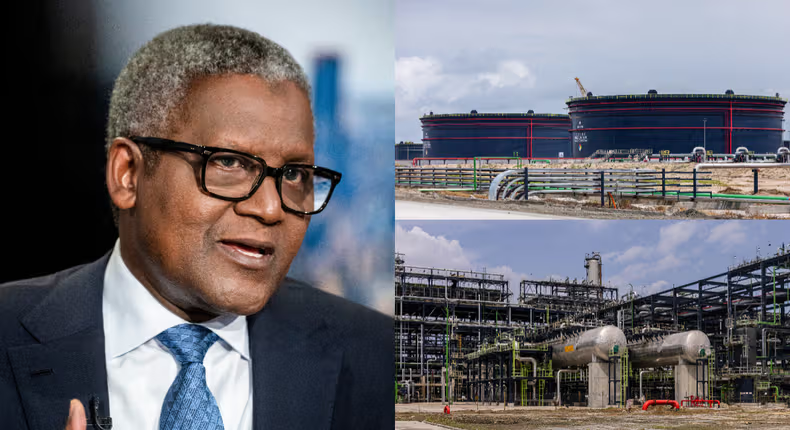
Nigeria’s industrial giant Dangote Group has struck expanded gas supply agreements with units of the Nigerian National Petroleum Company Limited (NNPC Ltd.), reinforcing energy security for its refinery, fertiliser, and cement operations as part of a broader expansion push. The move was unveiled during the launch of the Nigeria Gas Master Plan 2026 in Abuja, signaling a strategic step toward boosting energy supply and positioning Nigerian products for export markets like the United States, United Kingdom and beyond.
Under the revised Gas Sales and Purchase Agreements (GSPAs), three Dangote subsidiaries — Dangote Petroleum Refinery, Dangote Fertiliser Plant, and Dangote Cement Plc — have scaled up long-term contracts with Nigerian Gas Marketing Limited and NNPC Gas Infrastructure Company Limited (NGIC). These contracts are aimed at securing reliable natural gas supplies to meet rapidly growing energy demands driven by expanding refinery capacity and industrial operations. Officials say the strengthened agreements are a key part of Dangote Group’s “Vision 2030” strategy, designed to increase production, diversify energy sources, and support cleaner, more efficient industrial growth. Reliable gas supply is critical for the refinery’s planned capacity increases, for the fertiliser plant’s output (which depends heavily on gas feedstock), and for cement production, where gas will help power operations and promote the use of compressed natural gas (CNG) for industrial transport. The gas deals align with the federal government’s broader agenda to transform Nigeria’s energy sector under the Gas Master Plan 2026, which aims to significantly expand domestic gas production and usage. Officials say the plan could boost national output to 10 billion cubic feet per day (bcf/d) by 2027 and 12 billion bcf/d by 2030, while attracting over $60 billion in investments into the gas value chain. Industry analysts believe securing long-term gas supply contracts will not only underpin Dangote’s expansion but also enhance Nigeria’s competitiveness in global markets. With improved energy reliability and increased production capacity, the refinery and related industrial facilities are better positioned to meet both domestic demand and export opportunities — particularly to developed markets like the US and UK, where demand for quality refined products continues to grow.
About The Author