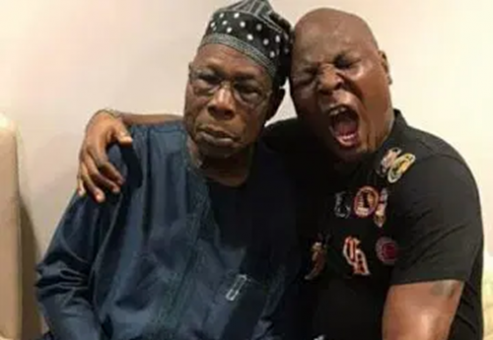
When veteran entertainer and activist Charly Boy speaks, he rarely holds back. Known for his bold personality, unconventional lifestyle, and fearless political commentary, the self-styled “Area Fada” recently opened up about what he describes as his “uncommon” relationship with former Nigerian President Olusegun Obasanjo — and the revelation has stirred fresh conversations across social media and political circles alike.
Charly Boy explained that his bond with Obasanjo is far from the typical alliance people expect between a radical activist and a former military ruler turned civilian president. For years, many have seen him as a persistent critic of the Nigerian political establishment, often leading protests and speaking loudly against bad governance. Yet, behind the scenes, he says his connection with Obasanjo has been built on something deeper than politics ,mutual respect, frank conversations, and the ability to disagree without becoming enemies.
According to him, their relationship is “uncommon” because it thrives on honesty rather than sycophancy. Charly Boy noted that he does not hesitate to challenge Obasanjo when he feels the former president is wrong, just as Obasanjo does not shy away from telling him hard truths. In a political climate where loyalty is often equated with silence, he says their dynamic stands out because it allows room for blunt exchanges without bitterness.
The entertainer also reflected on how Nigerians sometimes struggle to understand that two people can share ideological differences yet maintain personal rapport. For him, engaging powerful figures is not about endorsing everything they have done, but about keeping dialogue open. He suggested that meaningful change can only happen when activists and leaders are willing to confront issues face-to-face rather than shouting across divides.
Charly Boy further hinted that over the years, he has had private discussions with Obasanjo about national issues, youth empowerment, and governance. While he did not disclose specific details, he emphasized that these conversations were never transactional. Instead, he described them as exchanges between two strong-willed individuals who may see Nigeria’s problems from different angles but share concern for the country’s future.
For observers, the revelation adds a new layer to Charly Boy’s public persona. Long known for challenging authority, organizing protests, and championing social causes, he has built a reputation as a cultural rebel. Yet his “uncommon” relationship with Obasanjo suggests that influence can sometimes operate quietly, beyond the glare of microphones and placards.
Ultimately, his comments underscore a broader lesson about leadership and activism in Nigeria’s complex political landscape: relationships do not have to fit neat boxes. Sometimes, the most unlikely alliances can foster conversations that shape perspectives behind the scenes. And in a nation where political discourse is often polarized, Charly Boy’s candid admission serves as a reminder that dialogue , even between contrasting personalities ,can be both possible and powerful.